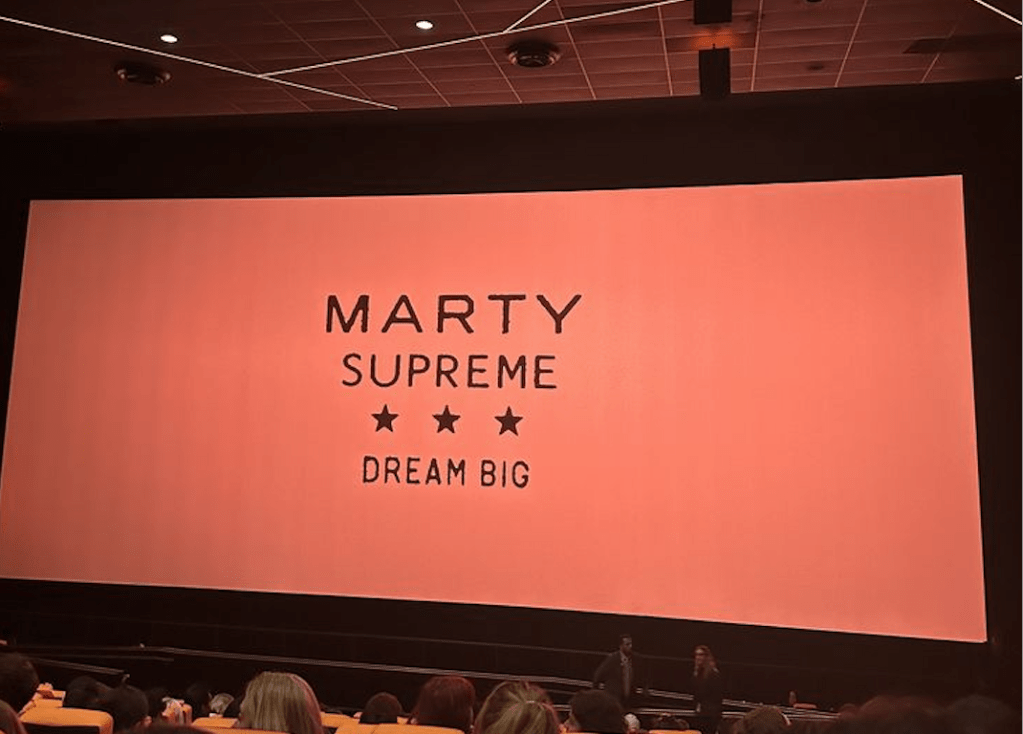
Nobody warned us that dedication can look ugly up close.
Not cinematic-ugly — not the glossy kind we’re taught to romanticise — but obsessive, isolating, almost embarrassing. Marty Supreme pretends to be a film about ping pong, but really it’s about a man who decides, over and over again, that belief in himself matters more than comfort, approval, or even joy. Strip away the table tennis, and what’s left is a portrait of devotion so total it borders on self-erasure. Watching Marty isn’t inspiring in the traditional sense — it’s confronting. Because at some point, you have to ask yourself: how much of yourself are you willing to give to the thing you say you love?
From the very beginning, the film makes it clear that ping pong is not the point. The tables, the matches, the sweat — they’re props. What we’re really watching is a man choosing dedication as an identity. Marty doesn’t do ping pong. He ishis dedication. Everything else — relationships, stability, social ease — becomes negotiable, expendable, secondary. The sport simply gives his obsession somewhere to land.
What makes Marty Supreme uncomfortable is how familiar this logic feels. We live in a culture that worships devotion, especially when it’s loud, singular, and masculine. We’re told that to want something badly is a virtue. That sacrifice equals seriousness. That the loneliest paths are often the most meaningful ones. Marty embodies that myth perfectly — and the film doesn’t rush to correct it.
Instead, it lets the obsession breathe.
There’s something almost claustrophobic about the way Marty moves through the world. Conversations are transactional. People orbit him briefly before falling away. The film doesn’t dramatise these losses with big emotional cues — it treats them as collateral damage. And that’s the point. When dedication becomes your moral compass, everything else starts to feel optional. Not unimportant — just inconvenient.
What’s striking is that Marty never seems confused about this. He doesn’t spiral in self-doubt. He doesn’t perform regret. There’s no grand monologue about balance or love or community. He simply keeps going. And culturally, that’s where the film gets interesting. Because we’re so used to narratives that either punish obsession or glorify it, watching a character exist somewhere in between feels unsettling. Marty is not framed as a villain. He’s also not framed as a hero. He’s framed as inevitable.
And maybe that’s the most honest thing the film does.
Because if Marty failed if all this devotion led nowhere his behaviour would be unbearable. He would be written off as delusional, arrogant, sad. But success changes the language. Obsession becomes “drive.” Isolation becomes “focus.” Difficulty becomes “complexity.” The film quietly exposes how achievement launders behaviour, how dedication is only celebrated once it produces something legible to the outside world.
This is especially visible in the way other characters respond to him. Marty doesn’t soften over time. He doesn’t become easier to love. What changes is how people tolerate him once his commitment starts to look justified. The film doesn’t need to say this out loud — it trusts us to notice. And in doing so, it asks a question that extends far beyond Marty himself: do we admire dedication, or do we just admire results?
There’s also something deeply modern about Marty’s devotion. His belief in himself isn’t grounded in community or tradition or even joy ,it’s solitary. Internal. Almost compulsive. He doesn’t seem motivated by legacy or recognition so much as by the terror of stopping. When everything else feels unstable, dedication becomes structure. Purpose becomes survival. The work gives him a reason to wake up, to keep moving, to exist.
That’s where the film quietly shifts from being about ambition to being about coping.
Because dedication, in this context, isn’t just a personality trait — it’s a strategy. A way of making the world smaller. A way of turning chaos into repetition. And repetition into meaning. Marty’s life may look extreme, but the impulse behind it is familiar: if I focus hard enough on one thing, maybe the rest won’t swallow me whole.
Still, the film refuses to let us romanticise this too easily. There’s no payoff scene where Marty looks fulfilled, surrounded, at peace. There’s no sense of arrival. Dedication, it suggests, doesn’t end — it just consumes. And while the culture loves to frame obsession as a path toward transcendence, Marty Supreme hints that it might just be a loop. A beautifully disciplined one, but a loop nonetheless.
What I appreciated most is that the film doesn’t tell us what to take from Marty. It doesn’t offer a lesson. It offers a mirror. Watching him forces you to confront your own relationship to ambition, to discipline, to the things you’ve chosen over people, rest, softness. It asks whether devotion is still admirable when it empties you out — and whether we’re brave enough to admit that sometimes, that emptiness is part of the appeal.
In a culture obsessed with productivity, branding, and self-mythology, Marty feels less like an outlier and more like an extreme version of something we’re all being encouraged to become. Focused. Singular. Willing to disappear into the work. The difference is that Marty doesn’t pretend this comes without cost.
Marty Supreme isn’t a motivational film. It won’t make you want to work harder. If anything, it makes you want to pause to interrogate what you’re chasing and why. It reminds us that dedication is powerful, but not neutral. That wanting something deeply can shape you, sharpen you, and also hollow you out.
And maybe that’s the most honest portrayal of devotion we’ve seen in a while. Not as a virtue. Not as a flaw. But as a force one that gives life meaning, and takes parts of you in return.
The question the film leaves us with isn’t whether Marty was right.
It’s whether we recognise ourselves in him and what we’re willing to lose to keep believing in the thing we say matters most.
see you next week, guys!
Perrine
© 2026 Culture-Anthology
 culture-anthology
Leave a comment